Showing posts with label Ecumenism. Show all posts

Monday, October 23, 2017

A Private Letter Concerning Ecumenism by Elder Paisios the Athonite


The Holy Mountain, January 23, 1969

Reverend Father Haralambos,

In as much as I see the great uproar which is happening in our Church because of the various movements of groups in favor of unification [of churches], as well as the interaction of the Oecumenical Patriarch with the Pope, I was pained as Her child, and considered it good, besides my prayers, to send a small thread (which I have as a poor monk), that it too may be used as a means of stitching together the multipart garment of our Mother. I know you will show love and share it only with your religious friends. Thank you.

First of all, I would like to ask forgiveness from everyone for being bold to write something when I am neither holy nor a theologian. I trust everyone will understand me, that my writing is nothing more than an expression of my deep pain for the unfortunate stance and worldly love of our father Patriarch Athenagoras.

It appears he loved another modern woman—which is called the Papist Church—because our Orthodox Mother has not made an impression on him at all, for She is so modest. This love, which was heard from Constantinople, caused a sensational impression of sorts among many Orthodox, who nowadays live in an environment of such meaningless love, in cities across the entire world. Moreover, this love is of the spirit of our age: the family will lose its divine meaning from just such kinds of love, which have as their aim breakup and not union.

With just such a worldly love the Patriarch takes us to Rome. While he should have shown love first to us his children and to our Mother Church, he unfortunately sent his love very far away. The result, it’s true, delighted the secular children who love the world—who have this worldly love—, but completely scandalized us, the children of Orthodoxy, young and old, who have fear of God.

Monday, September 26, 2016

Copts and Orthodoxy


A priest that I know says that the Copts are Orthodox, that they have been the victims of a theological misunderstanding by the Orthodox Church, and that they have a valid priesthood. He communes them and says that they are part of our Faith....You seem to think differently. Can you explain your position, which this priest says is old and outdated. He gave me an article by Bishop Maximos of Pittsburgh of the Greek Archdiocese. He says that Bishop Maximos is a great Patristic scholar and that his word, which supports the Copts as Orthodox, is final. (M.K., NY)

The Copts are Monophysites and thus heretics. Their Mysteries are invalid and, should they join the Orthodox Church, they must be received as non-Orthodox. Indeed, now that most Copts have rejected the errors of the Monophysite heresy, this is a time for their reunion with Orthodoxy. Here is a place for true ecumenism. But despite the fact that the time seems ripe, we must still rest on the Providence of God and restore the Copts to Orthodoxy in a proper way. One cannot say that he is Orthodox simply because he believes correctly and recites the Creed. He must be received into the Church by Chrismation or Baptism. The fact that the Copts were once Orthodox, fell away, and have now come to right belief is neither here nor there. Grace does not withstand generations of heresy and separation from the Church.

Anyone who believes that the Orthodox Fathers were wrong in condemning the Monophysites, and that the Copts have always been Orthodox, is guilty of blasphemy against the Church Fathers and the Ecumenical Synod at Chalcedon, which condemned the Monophysite heresy. He is also guilty of heresy, in that such a proposition presupposes not only that the Fathers of the Church were in error and that this error entered into the conscience of the Church, but that the Orthodox Church has for centuries been "divided" between the two "families" of right-believing Orthodox and the supposedly "right-believing" Copts. Moreover, such a view presumes that our Orthodox Fathers, ignorant of the truth, "divided" the Church over semantics and over word games.

Wednesday, June 15, 2016

On Praying with Heretics


Question: What does an Orthodox convert do when he attends the funerals of his heterodox friends or of his parents? I know that we cannot pray with non-Orthodox and should not compromise our Faith. The last time that a non-Orthodox friend died, a Roman Catholic, I left the funeral during the reading of the Epistle and the Gospel and during their communion. (J.C., RI)

Answer: The Canons of the Church forbid us to participate in non-Orthodox religious services and to engage in common prayer with non-Orthodox and with those who have been officially condemned as heretics by the Orthodox Church. Contemporary ecumenists react to these Canons with outrage, the Orthodox among them often maintaining that the Canons are outmoded, ineffective, "non-operational," or whatever. Many so-called Orthodox "traditionalists," on the other hand, invoke these Canons as evidence that the ecumenical movement is illicit, not a few of such individuals taking these proscriptions to a point that, quite frankly, smacks of religious bigotry. To understand the Canons correctly we must avoid these extremist reactions and combine a proper respect for the inspired content of Church laws with the sense of moderation constantly prescribed by the very Fathers who wrote and compiled them.

Firstly, we must distinguish between those who have been condemned by the Church as heretics and those who embrace incorrect or heterodox doctrines. Like it or not, Latin Christianity has been condemned by numerous Fathers and several local councils as heretical. It is, indeed, a traditional Orthodox position that, lamentable though the fact may be, the Orthodox and Latin Churches are divided over the fall of the latter to heresy (e.g., papism, the dogma of the Immaculate Conception, the filioque innovation, etc.). Therefore, it is clear that Orthodox may not participate in joint services with Latin Christians. 

Saturday, November 29, 2014

Papism as the Oldest Protestantism by the Blessed Fr. Justin Popovich


What are, on the other hand, the fruits of the God-Man society [the Church]?—Saints, Martyrs, and Confessors. That is its goal, that is its meaning and design, that is the proof of its indestructible strength. Not books and libraries, systems and cities—all things that are here today and gone tomorrow. The various pseudo-Christian humanisms fill the world with books, while Orthodoxy fills it with the hallowed.

In the European West, Christianity has gradually transformed into humanism. For a long time and arduously, the God-Man diminished, and has been changed, narrowed, and finally reduced to a man: to the infallible man in Rome and the equally "infallible" man in London and Berlin. Thus did papism come into being, taking everything from Christ, along with Protestantism, which asks the least from Christ, and often nothing. Both in papism and in Protestantism, man has been put in the place of the God-Man, both as the highest value and as the highest criterion. A painful and sad correction of the God-Man's work and teaching has been accomplished.

Friday, November 28, 2014

The Orthodox Church in Romania versus Ecumenism


The excerpt below has been taken from the Minutes of the Inter-Orthodox Convention which took place in the Aristotelian University of Thessaloniki, on the 20-24th September 2004.


Topic: "Origin - Expectations - Disprovals"
Minutes of the Inter-Orthodox Scientific Convention held in the Aristotelian University of Thessaloniki - 20 to 24 September, 2004.

"THEODROMIA" PUBLICATIONS
Hieromonk Vissarion - Hierodeacon Leon[1]
Sacred Monastery of the Archangels, Neamts.


"....By remaining steadfastly in the Faith of the Holy Fathers of Orthodoxy, we stand today as the carriers of the words of most monks and nuns of Romania who are opposed to Ecumenism, by conveying the desire for unity in Orthodoxy and the true witness of the Apostolic Traditions of the Holy Fathers, and in order to inform the Orthodox faithful of the world that the heresy of Ecumenism is striving to undermine the One, Holy, Catholic and Apostolic Church.

The hypocrisy by which the New Age mentality is daily becoming rooted in our lives is indescribable. Beneath the mask of man-centred love and not of the love of Christ-centred Humanism, Ecumenism with its promotion of syncretism, religious socialism and common prayer with other religions and Christian confessions, is striving - thanks to this immense apostasy - to establish the reign of the Antichrist on earth. The biggest temptation is that the evil spirit is seeking fervently to break us away from Orthodoxy and render us labourers of the new Babylonian temple, for the material rule of the Antichrist in this world.

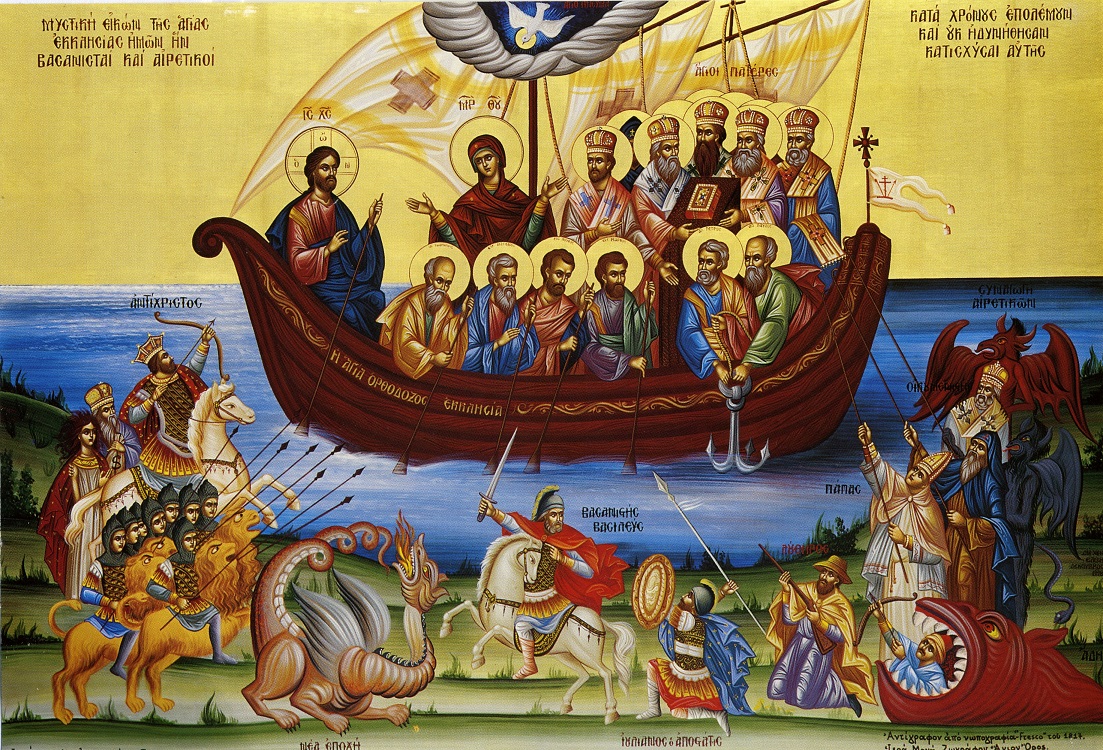
Before moving on to any kind of judgment regarding the things of the Faith, we must not overlook the testimonies of our predecessors, who knew how to "fight the good fight" and be victorious to the end. The Holy Prophets, Evangelists, Apostles, Hierarchs, Confessors, Martyrs and Saints have, throughout the ages and in every place, unanimously confessed that the Orthodox Church is the Bride of our Lord Jesus Christ, and the Ark of our Salvation.

Thursday, November 27, 2014

Orthodox Saints and the Ecumenical Movement


For Christians, the criterion of truth is fidelity to Christ and the faith that was “once for all delivered to the saints” (Jude 3).

The Saints, being wholly united to Christ by the Spirit in his holy Church, in turn become the empirical datum par excellence by which truth is measured. This is why, for Orthodox Christians, the teachings of the Holy Fathers are received as an authority to be followed and believed, far and above whatever opinions any individual or group may have.

I offer this foundational belief as a preface to discussing the issue of relations between the Orthodox Church and the See of Rome, which in light of the forthcoming Apostolic Pilgrimage is a topic generating some discussion in ecclesiastical circles.

Since Vatican II, Rome has developed the ecclesiological notion that our schism is a matter of separated ‘sister churches,’ and that the Orthodox Church ‘lacks little to attain the fullness that would permit a common celebration of the Lord’s Eucharist.’[1]. Does the Orthodox Church share this understanding of the schism and the status of the Roman Catholic church? To answer that question, we must turn to her Saints and synodal decrees. And when we do, the answer is a rather unambiguous ‘no’.

When we examine the controversies with Rome in the lives of St. Photios the Great and St. Mark of Ephesus (in the ninth and fifteenth centuries respectively), we find clear repudiations of Rome for her heresies—so long as she holds to them—and in the latter case, a rejection of the possibility for union with her for that very reason. In the eyes of the Orthodox Church—who not only canonized these men, but deemed them ‘Pillars of Orthodoxy’—their teaching with respect to Rome was vindicated over against papism, filioquism, and ecumenism. St. Photios’ teaching against the Filioque and papal supremacy was formally affirmed by the Church at the ecumenical Council of Constantinople (A.D. 879–880), and St. Mark was vindicated and affirmed in the Church’s rejection of the false union of Basel-Ferrara-Florence.

Tuesday, November 11, 2014

Why Orthodox Christianity Should Not Change with the Times by St. Theophan the Recluse

It reached my ears that, as it seems, you consider my sermons very strict and believe that today no one should think this way, no one should be living this way and therefore, no one should be teaching this way. “Times have changed!”

How glad I was to hear this. This means that you listen carefully to what I say, and not only do you listen, but you are also willing to abide by it. What more could we hope for, we who preach as we were ordered and as much we were ordered?

Despite all this, in no way can I agree with your opinion. I even consider it my duty to comment on it and to correct it, since – even though it perhaps goes against your desire and conviction – it comes from something sinful, as though Christianity could alter its doctrines, its canons, its sanctifying ceremonies to answer to the spirit of each age and adjust itself to the changing tastes of the sons of this century, as though it could add or subtract something.

Yet, it is not so. Christianity must remain eternally unchanging, in no way being dependent on or guided by the spirit of each age. Instead, Christianity is meant to govern and direct the spirit of the age for anyone who obeys its teachings. To convince you of this, I will put forward some thoughts for you to consider.

Some said that my teaching is strict. First of all, my teaching is not my own, nor it should be. In this sacred office nobody should, nor even can, preach his own teaching. If I or someone else ever dare to do so, you can put us outside the Church.

Saturday, May 24, 2014

The Miracle of St. Spyridon in Corfu, An Opposition to False Christian Unity


After Corfu's deliverance from a siege by the Turks - owing to the protection of St. Spyridon the Wonderworker - on August 11, 1716, Andrea Pisani, the governor and captain-general of Corfu, wished to do something in order to thank the saint for his great benefaction concerning the aforementioned deliverance. He consulted a papist theologian, Francisco Frangipani, as to what he should do, what would be best and well-pleasing to the saint.

The theologian said that it would be a very good and holy deed to build a precious marble altar inside the Church of St. Spyridon, so that they could perform a Latin mass inside. And "Your excellency can hear the mass in your own language when you are present there," he said. The theologian's counsel pleased the governor, and he ordered that the materials be prepared at once.

However, before the materials were made ready, it seemed appropriate to him to call the priests of that church (where the relics of the divine Spyridon were housed) and find out in what way they could be of assistance. As soon as they heard the unexpected news, they told him bluntly that this was a dangerous innovation, and they wished in no way to help him with his plan. The governor replied angrily that even if they were not willing to help, as the supreme authority he would do as he wished and would command that the materials be gathered outside the saint's church without fail. So there was gathered together asbestos, plaster, marble, and a slab from select marble, superbly crafted for an altar.

Wednesday, May 14, 2014

Met. Athanasios of Lemesou (Cyprus) Speaks Out on the Pope's Visit to Cyprus

In an interview published on May 23, 2010 in the Cypriot Newspaper "Phileleftheros" the Metropolitan distances himself from the Archbishop's decision to host the Pope in Cyprus.  The following are excerpts from the interview:The Metropolitan of Limassol Athanasius separates his position from that of the official position of the Church of Cyprus on the matter of Pope Benedict's visit to Cyprus.

He boldly declares that he is opposed, with the argument that Papism is a heresy and that the visit here of the Primate of the Catholic Church will scandalize the souls of innocent pious Christians. At the same time, he stresses that there should be no displays of unseemliness, no rudeness, no bad behaviour.  He has personally stated that he will not participate in the reception schedule.


"For us Orthodox, the Pope is a heretic, outside of the Church, and, hence, not even a bishop".

"He [the Pope] has been outside of the Church for ten centuries now, he is not a canonical bishop, he has no relation whatsoever to the reality of the One, Holy, Catholic, and Apostolic Church of Christ. It is one thing to receive him as a canonical bishop and quite another to speak to him as [being] a heterodox in order to reveal to him the truth of the Orthodox Faith and Tradition."

"Dialogue is not a bad thing when it is carried out based on correct presuppositions. However, it is wrong to say to these people that we recognize them as a Church, that we recognize the Pope as a Bishop, as our brother in Christ in the priesthood and in [the] faith. I cannot accept this, because we are lying [when we say this], since all of the Holy Fathers teach exactly the opposite. Papism is a heresy and the source of many other heresies which trouble the entire world today. A contemporary Saint of the Church, Saint Justin Popovich, said that in the history of the human race there have been three tragic falls: of the first-formed Adam, of the disciple of Christ, Judas, and of the Pope, who, when he was the first Bishop of the Church, fell from the apostolic faith, was cut off from the canonical Church and lured away a host of people with him until today."